

 EN
EN

Large-Scale Sample Analysis of 848 Cases Uncovers the "Micro-shift" Trap in Microsatellite Instability Detection for Endometrial Cancer
Following the inclusion of endometrial carcinoma molecular typing in the International Federation of Gynecology and Obstetrics (FIGO) staging and its integration into multiple clinical guidelines worldwide, molecular typing has become an indispensable part of the clinical diagnosis and treatment of endometrial carcinoma. Accurate assessment of MSI-H/dMMR status serves as a core component for precise molecular typing, Lynch syndrome screening, prognostic evaluation, and identification of immunotherapy-eligible populations.
Distinct from colorectal carcinoma, endometrial carcinoma presents a unique micro-shift phenomenon (microsatellite shift, defined as length variation of only 1 to 2 nucleotides; up to 84.5% of affected cases exhibit micro-shift at one or more loci). In comparison with next-generation sequencing (NGS), conventional detection via polymerase chain reaction (PCR) has a higher propensity to yield false-negative results, and faces greater challenges in setting critical cut-off values.
Recently, the team led by Professor Zhou Xianrong from the Obstetrics and Gynecology Hospital of Fudan University published a large-sample study of 848 cases in Chinese Journal of Pathology. The study analyzed the occurrence and distribution of MSI-H in endometrial precancerous lesions and different histological subtypes of endometrial cancer, compared the coincidence rate between dMMR and MSI-H detection results, and explored the incidence of micro-shift as well as feasible solutions for accurate interpretation of MSI-H status. As the supplier of the NGS detection kit (Human Endometrial cancer Molecular Classification Detection Kit) adopted in this study, SpaceGen joins clinical and pathological experts to address this challenge. This article elaborates on the core data of the study, and discusses how to avoid the "micro-shift" trap to achieve accurate classification of MSI-H status.
PART1:Incidence of MSI-H differs significantly between endometrial precancerous lesions and endometrial cancer
The present study enrolled 93 cases of endometrial atypical hyperplasia and 755 cases of endometrial cancer with various histological subtypes. The statistical results are presented as follows:
· For endometrial atypical hyperplasia: the incidence of dMMR was only 4.3% (4/93), and the incidence of MSI-H was only 3.2% (3/93). All of the 3 MSI-H cases were confirmed as Lynch syndrome after etiological verification.
· For endometrial cancer: the incidence of dMMR was 24.9% (188/755), and the incidence of MSI-H was 23.0% (174/755).
The difference between the two groups reached the level of statistical significance (dMMR: χ²= 16.85, P< 0.001; MSI-H: χ²=17.05, P<0.001).
**Clinical Implications**: With the exception of cases associated with Lynch syndrome, MSI-H in the majority of sporadic endometrial carcinomas represents a secondary event during tumor development, and occurs extremely rarely at the precancerous lesion stage. This finding suggests that patients diagnosed with MSI-H at the endometrial atypical hyperplasia stage require close clinical vigilance for the possibility of underlying Lynch syndrome.
PART2:The overall coincidence rate of dMMR and MSI-H is 90.6%, with substantial variation across different histological subtypes
Immunohistochemical detection of MMR proteins and NGS/PCR-based MSI status detection are two routinely applied approaches for molecular typing. In the present study, the overall coincidence rate between the two methods was 90.6%. Nevertheless, the coincidence rate decreased remarkably within specific subgroups.
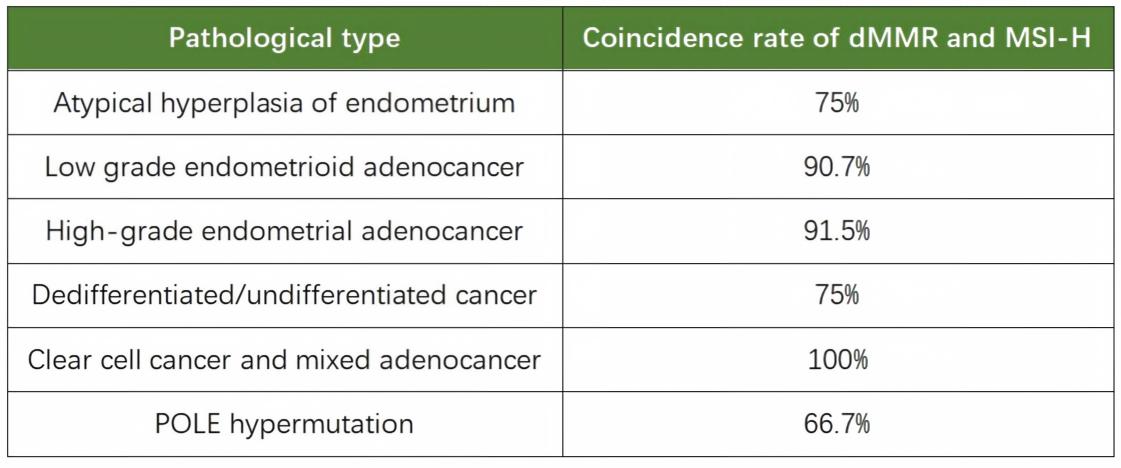
Supplement: In this study, the other subtypes included 94 cases of endometrial serous carcinoma, 6 cases of clear cell adenocarcinoma, and 2 cases of gastric-type mucinous adenocarcinoma, all of which were detected as pMMR/MSS.
The coincidence rate for POLE hypermutation subtype was only 66.7%, which was significantly lower than that of the MSI-H subtype (93.1%) (χ²= 13.35, *P*<0.001). This indicates that the abnormal expression of MMR protein in POLE hypermutation endometrial carcinoma may not be caused by genuine defects in mismatch repair function, but rather a "secondary phenomenon" accompanying POLE high-frequency mutations. In cases with POLE hypermutation, relying solely on IHC to determine dMMR status may lead to misjudgment of MSI status.
PART3:High Prevalence of Micro-Deviation: 84.5% of MSI-H Cases Exhibit Locus Shifts in at Least One Locus
This represents the most notable finding of the present study, and also constitutes the primary challenge encountered in MSI detection for endometrial carcinoma. Among the 174 MSI-H cases enrolled in this study, the overall incidence of micro-deviation in at least one locus was 84.5% (147/174). Among affected cases, the proportions of micro-deviation occurring at 1 locus, 2 loci, and ≥3 loci were 6.9%, 9.8%, and 67.8%, respectively; the proportion of cases without any micro-deviation was only 15.5%. Furthermore, the incidence of micro-deviation varied substantially across different histological subtypes, ranging from 42.9% to 100%..
PART4:Approximately 11.5% of MSI-H cases fall into a critical gray zone, requiring cautious interpretation during status judgment.
Among the 174 MSI-H cases included in this study, 20 cases (11.5%) had MSI scores located within the critical interval (0.3±0.05). The molecular characteristics of these cases are highly representative:
· For the MMR immunohistochemical phenotype: co-loss of MLH1/PMS2 accounted for 12 out of the 20 cases, and isolated loss of MSH6 accounted for 6 of the 20 cases.
· For gene mutation profiles: among the 12 cases with co-loss of MLH1/PMS2, MLH1 mutations were detected in half of the cases (6/12); among the 6 cases with isolated loss of MSH6, MSH6 mutations were detected in 5 cases.
· For the characteristics of MSI locus shifts: all 20 cases presented multi-locus micro-shifts, with every case exhibiting ≥3 micro-shifts per cases.
· For histological characteristics: all 20 critical-value cases presented the typical morphological features of MSI-H endometrial cancer, including uneven peritumoral lymphocyte infiltration, higher prevalence of MELF pattern invasion, and increased incidence of intravascular tumor thrombi, among other features.
PART5:Why is endometrial cancer prone to micro-deviation?
Micro-deviation, defined as microsatellite length shifts of only 1–2 nucleotides, is significantly more prevalent in endometrial cancer than in colorectal cancer, with a prevalence of 40%–52% versus 5%–10%, respectively. This disparity is primarily attributable to the distinct characteristics of MMR defects in endometrial cancer: specific types of MMR defects, such as isolated loss of MSH6 expression or combined loss of MLH1/PMS2 expression, tend to induce small length shifts (1–3 nucleotides) in single nucleotide repeats, rather than the large fragment length shifts that are commonly observed in colorectal cancer.
PART6:Comprehensive Strategies for MSI-H Status Judgment in Endometrial Carcinoma
1. Increasing the number of detected microsatellite loci: For traditional PCR-based detection schemes (e.g., the Bethesda panel), the high prevalence of micro-deviation in endometrial carcinoma significantly affects the judgment of MSI-H status. The second-generation sequencing approach can be adopted to detect a larger number of MSI loci, improving detection accuracy for endometrial carcinoma.
2. Incorporating visual graphic comparison: Micro-deviation cases may be misjudged or missed if classification relies solely on MSI-score values, thus graphic interpretation remains a necessary supplementary approach.
3. Referencing MMR protein immunophenotyping and histological characteristics: For cases with ambiguous classification (dMMR/MSS status) or threshold-scoring results, comprehensive judgment should be made by integrating IHC results, histological morphological features (e.g., lymphocyte infiltration, MELF pattern invasion), other molecular phenotypic characteristics, and the patient's disease course.
4. Alerting to "pseudo-dMMR": For cases involving endometrial atypical hyperplasia, carcinosarcoma, dedifferentiated/undifferentiated carcinoma and POLE hypermutation molecular subtype, further validation is required, and extra caution should be taken during result interpretation.
PART7:SpaceGen Solutions: A Panel Designed for Endometrial Cancer Molecular Typing
01. MSI loci specifically designed for endometrial cancer
Different from the general-purpose MSI detection panel for pan-cancer detection, this kit is equipped with MSI detection loci specifically developed for endometrial cancer. The design fully incorporates the high incidence of micro-deviation in endometrial cancer. SpaceGen has collaborated with Professor Zhou Xianrong’s team from the Obstetrics and Gynecology Hospital of Fudan University to co-develop a microsatellite instability detection method based on single-sample high-throughput sequencing targeting micro-deviation at microsatellite loci, which effectively improves the detection sensitivity of MSI-H, and the two parties have jointly filed relevant patent applications.
02. Visual graphic comparison enables accurate identification of micro-deviation
The research team has established a visual interpretation system for micro-deviation: NGS data are applied to simulate capillary electrophoresis to generate a histogram, where the horizontal axis indicates the number of microsatellite unit repeats and the vertical axis indicates the proportion of corresponding repeat numbers. Visual comparison between the histogram of the sample to be tested (marked in red) and the background baseline (marked in blue) enables accurate identification of micro-deviation loci.
SpaceGen's detection scheme also supports this graphical analysis, helping pathologists and clinicians intuitively judge microsatellite status and avoiding judgment errors caused by relying solely on numerical interpretation.
03. Comprehensive coverage of molecular typing
Based on TCGA molecular typing standards, this kit detects the status of 28 genes including POLE, MMR, TP53 and MSI, and can complete complete molecular typing of endometrial cancer through a single detection. This product was jointly developed with the Department of Pathology of Obstetrics and Gynecology Hospital of Fudan University, and underwent optimization modification by the Department of Pathology of Peking University Third Hospital. It has been awarded the Shanghai Silver Award for Inventions.
References
Chen TT, Liu TQ, Tao X, Sun YH, Zhou XR. Microsatellite status and minimal microsatellite shift in atypical endometrial hyperplasia and endometrial cancer: an analysis of 848 cases. CHINESE JOURNAL OF PATHOLOGY. 2026 Jun 8; 55(6):570-575. doi: 10.3760/cma.j.cn112151-20250916-00617. PMID: 42252218.
Statement: This article is only for sharing, if it involves copyright issues, please contact us as soon as possible, we will correct the first time, thank you!






 闽公网安备35021202000745