

 EN
EN

Capivasertib is Approved for Patients with PTEN Deficiency in Prostate Cancer
On June 12, 2026, the U.S. Food and Drug Administration (FDA) officially approved Capivasertib (Truqap) in combination with Abiraterone and Prednisone for the treatment of metastatic hormone - sensitive prostate cancer (mHSPC) with PTEN deficiency. This represents the world's first and sole approved targeted drug for this specific subtype of prostate cancer. Consequent to the drug's approval, the detection of PTEN deficiency has been elevated from a “scientific research indicator” to a “clinical essential requirement”.
PART 1
PTEN Deficiency: The “Brake” for Cancer Suppression Malfunctions, Propelling Tumor Malignancy Progression
PTEN deficiency represents one of the most prevalent genetic mutations in prostate cancer. A succession of clinical investigations in recent years have demonstrated that the incidence of PTEN deficiency has exhibited a step - wise increase in tandem with the progression of prostate cancer. The incidence among mHSPC patients is approximately 25 - 40% [1], and the incidence in metastatic castration - resistant prostate cancer (mCRPC) is around 40% - 60% [2].
PTEN occupies a pivotal position within the PI3K/AKT/mTOR signaling pathway. When PTEN is defective, it facilitates unregulated tumor proliferation and obstructs apoptosis. It stands as one of the crucial driving events that promote the development of prostate cancer and the exacerbation of the disease [3]. A multitude of studies have also verified that PTEN defects are significantly associated with the poor prognosis of prostate cancer patients and serve as an important predictive prognostic factor[4, 5] .
PART 2
Clinical Trial Data: Capivasertib Significantly Prolongs Survival and Revamps Treatment Standards
1. Experimental Design (CAPItello - 281, Phase III)
Enrolled Population: A total of 1012 patients with metastatic hormone - sensitive prostate cancer (mHSPC) were recruited, and PTEN deficiency was verified via the FDA - approved companion diagnostic VENTANA PTEN (SP218) immunohistochemistry (IHC) test.
Grouping Plan: The experimental group received Capivasertib in combination with Abiraterone, Prednisone, and androgen deprivation therapy (ADT); the control group was administered a placebo along with Abiraterone, Prednisone, and ADT.
Main Research Endpoints: Radiographic progression - free survival (rPFS); Secondary Endpoints: Overall survival (OS) and safety.
2. Core Efficacy Data: The progression-free survival (rPFS) was prolonged by 7.5 months, and the risk of mortality was decreased by 19%.
Median rPFS: The median rPFS in the test group was 33.2 months, compared with 25.7 months in the control group, representing a prolongation of 7.5 months (Hazard Ratio (HR) = 0.81, 95% Confidence Interval (CI): 0.66 - 0.98, P = 0.034);
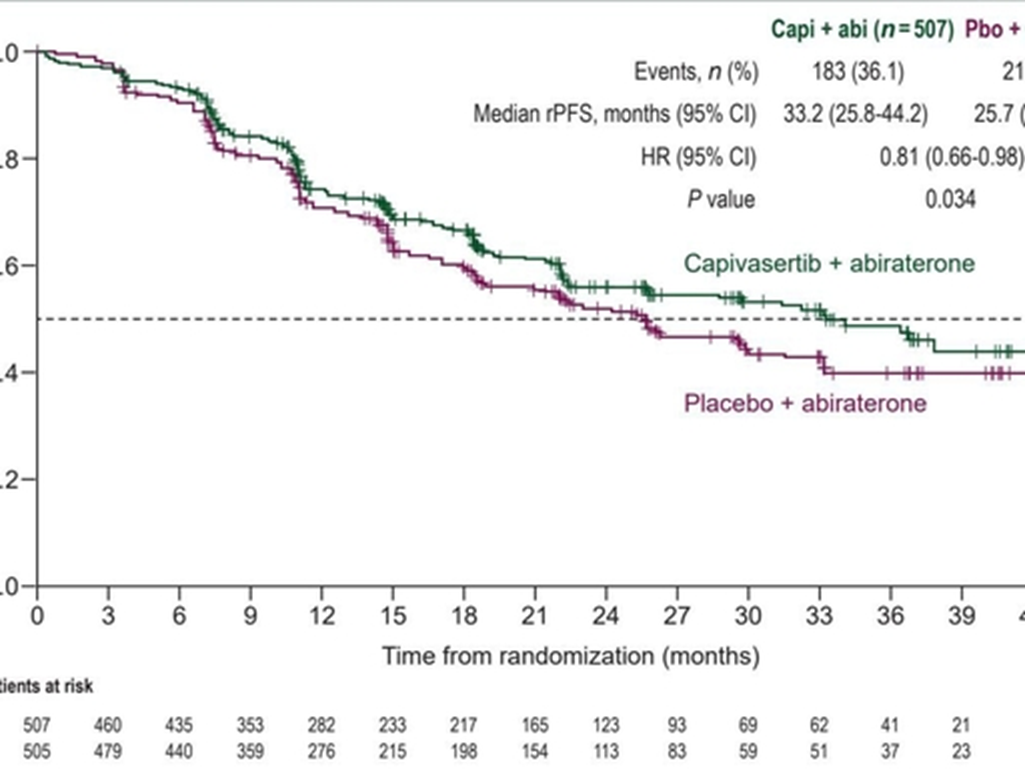
▲Figure 1. Comparison of therapeutic effects of medication rPFS data
PART 3
Multi - cancer Application: Capivasertib's Approval for Multiple Cancer Types and the Indispensability of PTEN Detection
Capivasertib is not solely indicated for prostate cancer. In April 2025, Capivasertib in combination with Fluvestrant was approved in China for the treatment of patients with HR - positive and HER2 - negative advanced breast cancer harboring PIK3CA/AKT1/PTEN mutations. It marked the first AKT inhibitor to receive approval in China. A clinical trial (CAPItello - 291) indicated that the objective remission rate (ORR) doubled, the median progression - free survival (PFS) was extended by 4.2 months, and the prognosis of patients with endocrine resistance was notably improved.
PART4
Comparison of PTEN Deletion Detection Methods: IHC, NGS, FISH - Which is the Optimal Solution?
FISH serves as the gold - standard method for detecting copy number deletions in the PTEN gene. However, given the existence of heterozygotes and homozygotes in PTEN defects, the detection process is intricate and necessitates the use of four - color probes. The consistency between FISH and immunohistochemistry ranges from 65% to 88% [6,7].
IHC can directly detect the expression of PTEN protein. It is a highly accessible and cost - effective detection method in China. The consistency between IHC and NGS in detecting PTEN defects is remarkably high, reaching 85.5% [8].
In terms of detection methods, NGS is regarded as the gold standard for detecting gene variants. Its drawback lies in the relatively high cost and longer cycle. When applied to advanced patients, the detection sensitivity needs to be taken into account. Its distinct advantage is that it can simultaneously detect PTEN gene deletions, mutations, and copy number variations, encompassing all gene - level abnormalities, and can also detect other target genes concurrently.
PART5
Summary
The approval of PTEN-targeted drugs signifies the shift of prostate cancer from the “era of hormone therapy” to the “era of precision targeting”. PTEN testing has the potential to become the standard for the precise diagnosis and treatment of advanced tumors, offering patients a longer survival duration and an improved quality of life.
References
[1] Ann Oncol, 2021, 32: S661.
[2] Cells. 2020 Oct 22;9(11):2342.
[3] Front Oncol. 2015 Feb 16;5:24.
[4] 2025 ASCO, Abstract 5096.
[5] 2025 ASCO, Abstract 5003.
[6] Oncotarget. 2017;8:65566–65576.
[7] Mod Pathol. 2013;26:835–848.
[8] Cancers 2021;13(19):4771.
Statement: This article is only for sharing. If it involves copyright and other issues, please contact us as soon as possible and we will correct it as soon as possible. Thank you!







 闽公网安备35021202000745