

 EN
EN

A New Perspective on Endometrial Cancer in the New Era: Insights from a Review in JAMA
In recent years, the incidence and mortality rates of endometrial cancer have been on a continuous upward trajectory, and the trend of younger onset has become increasingly prominent. It is no longer a stage - based tumor as conventionally perceived. The comprehensive review published in JAMA in April 2026 synthesizes the highest - level evidence from the past 15 years, including 31 randomized controlled trials (RCTs) and 17 international guidelines, and clearly demonstrates a significant shift in the understanding of endometrial cancer: from relying solely on staging, it gradually progresses towards a multi - dimensional analysis of "molecular + pathological + risk" tumors.

PART 01
The Epidemiological Characteristics of Endometrial Cancer Are Changing
Based on the epidemiology presented in the article, endometrial cancer has emerged as the fourth most prevalent tumor among American women. The incidence rate is continuously increasing, and the mortality rate is also on the rise (at an annual rate of 1.6%). Simultaneously, two trends have been observed: a trend of younger onset (with an annual growth rate of 3.0% among women aged 20 - 29 and 3.3% among women aged 30 - 39) and racial disparities (the mortality rate is 18.4 per 100,000 for black women and 8.1 per 100,000 for white women). The primary factors contributing to the poorer prognosis of black women include delayed diagnosis, more aggressive subtypes, and inconsistent implementation of treatment guidelines.
PART 02
Genetic Risk Factors
A multitude of hereditary cancer syndromes can notably elevate the risk of endometrial cancer. Female patients afflicted with Lynch syndrome face a lifetime risk of endometrial cancer ranging from 30% to 50% as a consequence of embryonic pathogenic variants in the mismatched repair protein gene. For patients with Cowden syndrome (characterized by pathogenic variation in the PTEN gene germ line), the risk stands at 5% to 22%; for patients with Peutz - Jeghers syndrome (marked by pathogenic variation in the STK11 gene germ line), the risk is 9%. Moreover, based on restricted data indicating a slight increase in the risk of endometrial cancer among carriers of BRCA hereditary pathogenic variants, the guidelines suggest that women with BRCA pathogenic variants contemplate simultaneous hysterectomies during fallopian tube oophorectomy to mitigate the risk of ovarian cancer.
PART 03
Molecular typing is emerging as the core of decision - making.
The traditional three elements, namely, FIGO staging, histology, and classification, still persist. Since the incorporation of molecular characteristics into the FIGO staging in 2023, molecular typing has become the new core of decision - making for endometrial treatment (serving as (the core basis for determining whether to downgrade or intensify treatment). This article focuses on four types of molecular typing: P53 wild - type, MMR - deficient type, P53 abnormal type, and POLE mutant type. Different types not only correspond to different prognoses but also influence treatment strategies.
Among them, the POLE mutant exhibits the most favorable prognosis, and treatment downgrading or exemption from adjuvant therapy can be contemplated;
MMR - deficient types indicate that immunotherapy can be employed, and they currently represent one of the most significant beneficiary groups;
The prognosis of P53 abnormality is unfavorable, and even relatively early - stage patients often need to more actively consider systemic treatment;
The P53 wild - type is the most prevalent type, and specific treatment must be comprehensively judged in combination with staging, histology, and other risk factors.
This also demonstrates that with the deepening of the understanding of endometrial cancer, the diagnosis and treatment judgment of endometrial cancer has gradually shifted from the traditional “pathology + staging” approach to the multi - dimensional combination direction of “molecular + pathology + staging”.
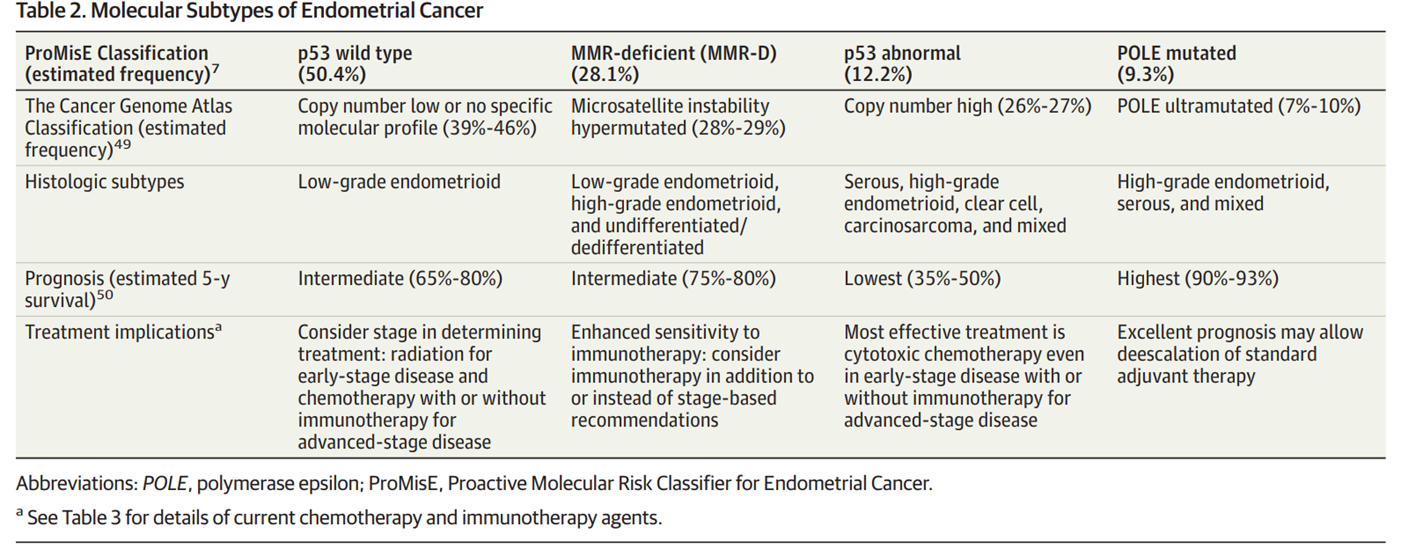
Molecular typing of endometrial cancer
PART 04
Post - operative Adjuvant Therapy Moving towards Individualization
Approximately 20% of early - stage patients will experience a relapse. High - risk factors for the recurrence of endometrial cancer encompass advanced age, infiltration of lymphatic vessel spaces, an increase in tumor classification, and a greater depth of muscle infiltration. The traditional approach involves observation for low - risk cases, vaginal brachytherapy or pelvic radiotherapy for high - risk cases, and chemotherapy or combination therapy for high - risk situations. Although the current treatment framework remains unchanged, this review indicates that molecular typing has been further optimizing post - operative adjuvant therapy. Research exemplified by PORTEC - 4a attempts to determine the intensity of adjuvant therapy based on the risk of molecular integration. Such studies essentially aim to demonstrate that the diagnosis and treatment of endometrial cancer have gradually shifted towards precise and personalized diagnosis and treatment. By leveraging different technologies, it is feasible to identify which patients can safely and effectively receive reduced treatment and which patients require intensive treatment.
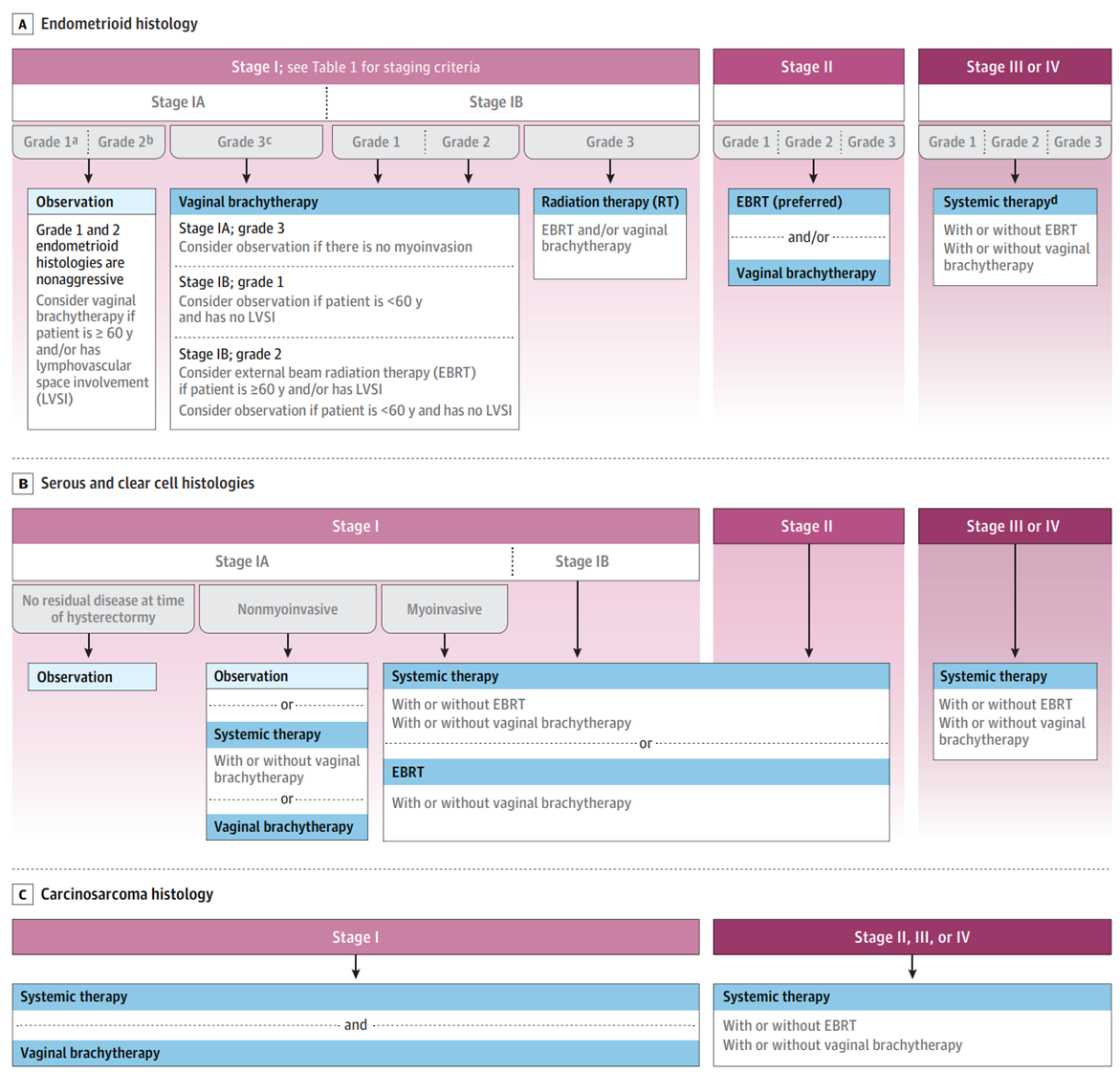
Adjuvant treatment decision-making in endometrial cancer post-surgery
PART 05
Advanced and Recurrent Patients: Immunotherapy Enters First - line Treatment
The standard first - line treatment for advanced and relapsed patients remains Carboplatin + Taxol. The review refers to two crucial studies: GY018 (Pembrolizumab) and RUBY (Dostarlimab), which advance immunotherapy and render it an important option for first - line treatment. Among these, patients with mismatch repair deficiency derive more pronounced benefits.
There exist multiple systemic treatment options for recurrent patients, encompassing targeted therapy and immunotherapy alternatives. Treatment selection is predicated on tumor histology, protein expression profile, molecular profile, and tumor - specific pathogenic variation.
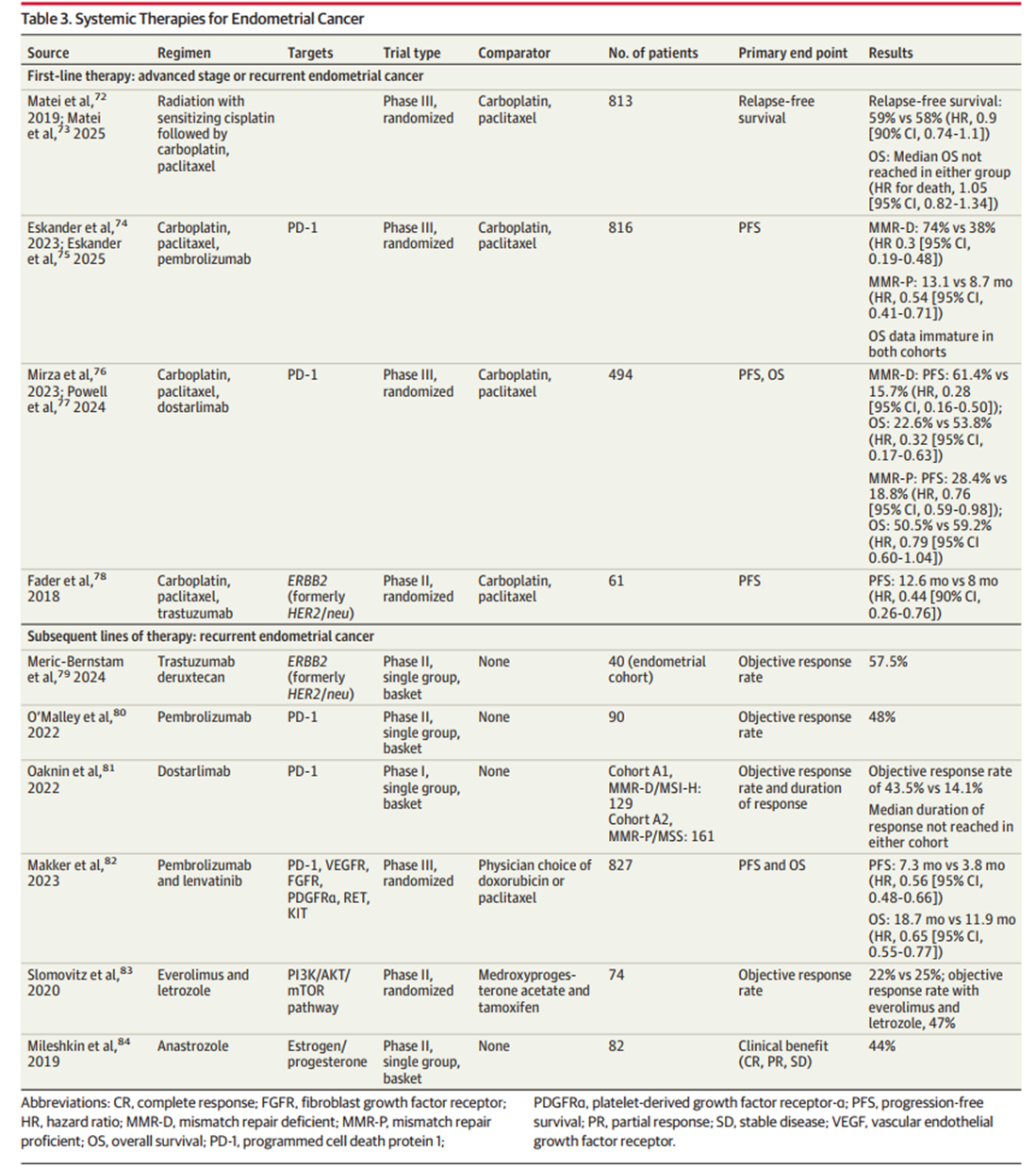
Systematic Treatment of Endometrial Cancer
PART 06
Summary
This review also referred to novel directions such as antibody - coupled drugs and cell therapy, encompassing HER2 - related drugs, folic acid receptor alpha - related drugs, as well as treatment strategies like TIL, CAR - T, and TCR. The new treatment directions indicate that patients with endometrial cancer may have a wider range of treatment options in the future, yet the original framework remains intact.
In the new era, the diagnosis and treatment approach for endometrial cancer has shifted from the traditional “pathology + staging” to the era of precision and individualization. It has become increasingly essential for doctors to administer treatments of varying intensities based on the actual risks of different patients. However, technology serves merely as an auxiliary tool, and professional doctors are required to make comprehensive judgments by integrating different dimensions (such as molecular, pathological, and staging factors) to further refine the diagnosis and treatment pathway for patients with endometrial cancer.
References
Mager KL, McLean K. Endometrial Cancer: A Review. JAMA. Published online April 13, 2026. doi:10.1001/jama. 2026.2248
Statement: This article is only for sharing. If it involves copyright and other issues, please contact us as soon as possible and we will correct it as soon as possible. Thank you!






 闽公网安备35021202000745